How PU Prime Scaled iOS Retargeting 7x in Six Months While Beating Its CPFTD KPI by 1.7x
Download the PDF version of the case study

We partnered with PU Prime to re-engage users who had signed up on its iOS trading app but hadn’t taken the next step: making their first deposit. PU Prime is a global online broker offering access to forex, gold, indices, and other financial instruments.
Results at a Glance
1.7x
Outperforming the CPFTD (cost-per-FTD) KPI
9 markets
CPFTD within KPI in every market
7x
Campaign scaling within 6 months
Campaign Goal
The goal of the campaign was to convert registered PU Prime users into first-time depositors (FTDs). These users had signed up but never funded their trading accounts.
The key challenge was to sift through a large pool of registered non-depositors, identify those most likely to make their first deposit, re-engage them at the most opportune time, and drive conversions efficiently.
PU Prime set a cost-per-first-time-deposit (CPFTD) target as the campaign’s primary performance KPI.

Working with Persona.ly has been a positive experience for us at PU Prime. We appreciate the team’s responsive communication and willingness to adapt campaigns to our goals.
Through our collaboration, we’ve focused on refining retargeting audiences and encouraging registered users to make their first deposit. We look forward to building on this partnership through continued testing and optimization.
Michael Sun, Performance Marketing at PU Prime
Programmatic Retargeting Strategy
At the start of the campaign, we used our proprietary Live Audiences segmentation engine to build a retargeting audience of PU Prime users who had registered in the app but had not yet made their first deposit.
Live Audiences supports segmentation based on multiple behavioral signals, including activity levels, purchase history, inactivity windows, and intent. Integrated directly with Persona.ly’s programmatic DSP, the engine updates and suppresses audiences in real time, ensuring that advertising spend remains focused on relevant users.
As the campaign generated conversion data, our ML-driven bidder learned which audience segments were more likely to return to the app and complete their first deposit. The bidder used this data to adjust bids and prioritize users with a higher predicted probability of making an FTD, rather than treating all registered non-depositors equally. This kept optimization focused on the campaign’s deep-funnel conversion event: the first deposit.
Single-Market Optimization
We initially launched the campaign in the UK, giving our bidder an opportunity to accumulate FTD conversion signals and identify the strongest-performing audience segments within a single market.
Market Expansion
As the bidder gathered sufficient conversion data, we gradually expanded the campaign into additional markets across Europe and North America. With each expansion, new market-level data informed further adjustments to bidding and audience segmentation. This iterative approach allowed us to scale while continuously optimizing toward audiences with a higher probability of converting and adjusting bids according to each audience’s predicted value, ultimately reaching nine markets.
By prioritizing audiences with the highest predicted likelihood of making a first deposit and allocating more budget to creative formats generating stronger conversion outcomes, we scaled monthly campaign spend by 7x while outperforming PU Prime’s CPFTD target by 1.7x overall.
Campaign Results
Campaign Scale and CPFTD KPI
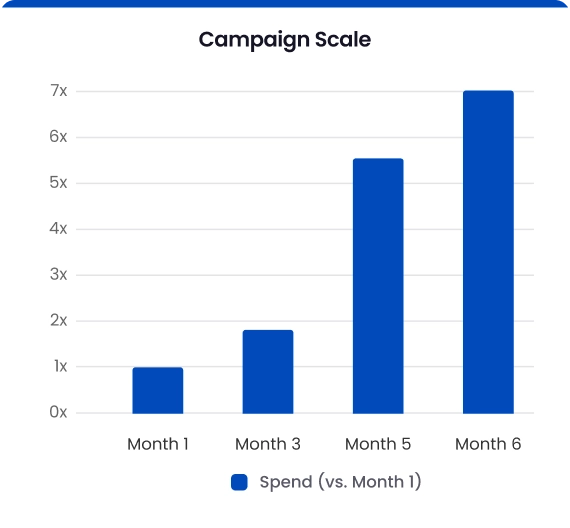
Following the initial learning period, we progressively scaled monthly spend by 7x while expanding the campaign into additional markets across Europe and North America.
Despite the increase in spend and global expansion, CPFTD remained below PU Prime’s target every month and across all nine markets, outperforming the KPI by 1.7x overall.
Reaching High-Intent and High-Value Audiences
Our DSP includes a proprietary whale-prediction capability designed to identify users predicted to rank among the top 1% by lifetime value (LTV). The bidder evaluates each programmatic auction based on the user’s predicted value and the market price, adjusting bids to improve the likelihood of winning valuable impressions while maintaining cost efficiency.
Originally developed for our gaming clients, this capability has since been applied to fintech and e-commerce, where a relatively small share of users can account for a disproportionate share of transaction value.
For PU Prime, the challenge went beyond identifying registered users likely to make their first deposit. Our programmatic bidder prioritized audiences with greater predicted LTV, generated either through multiple deposits or fewer deposits of higher value.
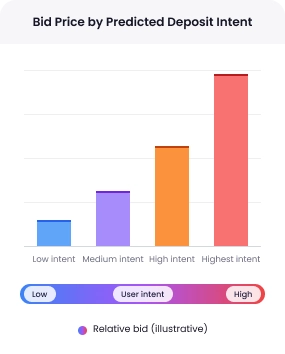
CPFTD measures how much it costs to acquire a first-time depositor, but it doesn’t consider how valuable that user might become. Higher-value audiences typically attract greater competition and command higher auction prices. Our bidder accounts for that difference by considering predicted user value alongside the likelihood of conversion and the cost of reaching each audience.
Incorporating predicted user value into our bidding strategy allowed us to bid more aggressively on users with greater deposit potential while keeping CPFTD below PU Prime’s target.
Success Factors in Programmatic Retargeting for PU Prime
Intent-Based Segmentation
Our ML-driven DSP used Live Audiences to combine multiple behavioral signals and classify registered non-depositors by their predicted likelihood of making a first deposit. These predictions were incorporated directly into real-time bidding, allowing the bidder to compete more aggressively for high-intent users while reducing spend on those less likely to convert.
Click-through Attribution
We focused on click-through attribution rather than relying on view-through attribution.
Unlike view-through attribution, which credits conversions following an ad impression, click-through attribution requires the user to actively engage with the creative.
This provided a more conservative way to assess campaign impact, with attributed re-engagements tied to an active user interaction rather than ad exposure alone.
About PU Prime
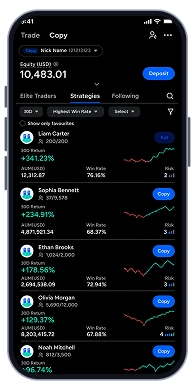
PU Prime is an award-winning global online broker offering CFD trading across forex, commodities, gold, indices and shares. Its mobile app gives traders access to hundreds of instruments, flexible account funding and PU Social, a copy-trading feature for newer traders.

The churn cliff doesn’t define a user’s lifetime value, especially for fintech trading apps, where market volatility can quickly shift user intent.
Our ML models adapt to the signals that predict first deposits, repeat funding, and long-term engagement, allowing our DSP to identify high-value opportunities and bid accordingly.
Retargeting gives fintech companies the opportunity to re-engage users with untapped potential and grow LTV well beyond the initial acquisition window.
Nicole Leus, Business Development Manager, EMEA & North America at Persona.ly
About Persona.ly
Persona.ly is a data-driven product company specializing in mobile user acquisition and retargeting, powered by proprietary machine learning algorithms and a robust first-party data management platform.
We help leading mobile companies, including King, Tencent, Papaya, NextNinja, Tilting Point, Nexon and many others reach and exceed their growth goals by accurately predicting which users are most likely to engage and convert. Our machine learning models are optimized to target high-value users based on predicted LTV, driving strong ROAS and long-term user quality.
Our in-house programmatic DSP is directly integrated with top-tier ad exchanges and OEMs, processing over 4 million ad requests per second globally.
By combining real-time predictive analytics with programmatic scale, we empower our partners to unlock smarter growth, higher LTV, and measurable incremental impact.
With IMPACT, our incrementality measurement platform, advertisers can go beyond attribution to understand the true incremental value generated by Persona.ly DSP. IMPACT provides transparent measurement across audiences, segments, and campaigns, connecting media exposure with incremental conversions, revenue, and iROAS.








Thank you for your interest!
Our team will get in touch with you shortly.
