How We Outperformed Playtika’s D7 ROAS KPI by 1.6x for Solitaire Grand Harvest
Download the PDF version of the case study

We partnered with Playtika to re-engage lapsed players of Solitaire Grand Harvest on iOS worldwide. Solitaire Grand Harvest is a skill-based game combining classic solitaire gameplay with farm-building mechanics.
Results at a Glance
1.6x
average D7 ROAS above the KPI
5.5x
campaign scaling over 11 months
Campaign Goal
The campaign aimed to re-engage lapsed Solitaire Grand Harvest players and bring them back into active gameplay.
For a title like Solitaire Grand Harvest, the key challenge was to identify, among millions of users, those most likely to return and make additional purchases in the payer segment.
We were presented with a ROAS-based KPI to measure the success of the campaign.

Persona.ly has been a reliable partner for us over time, consistently delivering while bringing valuable insights and a broader strategic perspective to the table. They don’t just focus on meeting the KPI – they look at where there is room to scale and help us identify new opportunities. That combination of stability, expertise, and strategic thinking is what has allowed us to expand our partnership across additional Playtika titles.
Tom Kaplan – User Acquisition Manager at Playtika
Programmatic Retargeting Process
At the initial stage, we focused on recently lapsed payers in the US. We leveraged our proprietary Live Audiences segmentation engine to slice-and-dice audience data and generate multiple audience segments based on user intent.
Our bidder then optimized bids across these segments, allocating higher bids to users with stronger predicted intent and bidding more selectively on lower-intent audiences.
As the campaign collected data, our ML-driven programmatic bidder identified audience segments with a higher likelihood of returning to the game and making additional purchases.
The main challenge at this stage was scalability. While the campaign was consistently hitting the KPI, scaling too quickly on a limited amount of data could cause the model to overfit to a narrow group of users and limit the available audience for additional spend.
Once our bidder collected sufficient data across audience segments, we developed a custom ML targeting model that consolidated multiple audience signals into a single bidding feature.
The model enabled the bidder to classify users based on their predicted purchase intent and optimize bids according to predicted ROAS, allowing us to expand beyond the initial high-intent cohorts while maintaining performance.
Once sufficient data was collected and the model was able to identify additional high-value users, we applied the learnings across additional markets and expanded the payer campaign worldwide.
This strategy allowed us to outperform the D7 ROAS KPI at every stage of the campaign, achieving an average 1.6x D7 ROAS outperformance over 10 months.
Campaign Results
Outperforming the D7 ROAS KPI at Scale
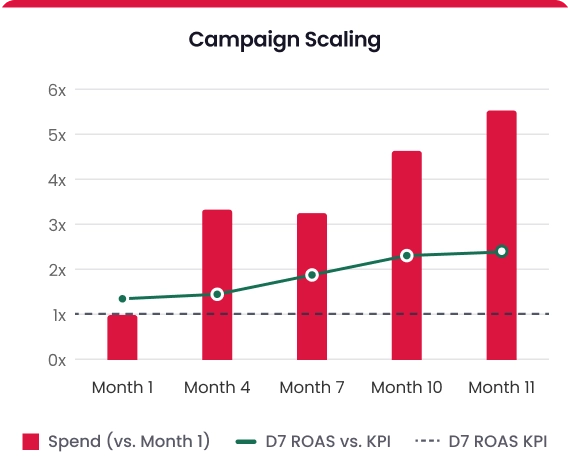
The campaign outperformed the D7 ROAS KPI in every month for 11 consecutive months, averaging 1.6x the KPI.
As the ML-driven bidder collected more data and the custom targeting model became more precise, we were able to scale campaign spend – reaching 5.5x – while continuing to outperform the KPI.
Following the worldwide expansion, D7 ROAS reached 2x the KPI.
Intent-Based User Segmentation
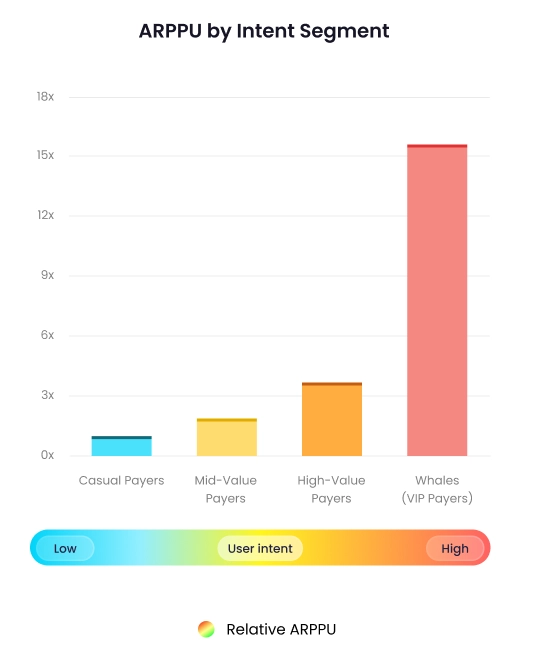
Using Live Audiences, we divided lapsed payers into cohorts based on predicted intent, and our bidder adjusted bids accordingly.
Campaign results showed a clear correlation between intent and post-re-engagement value: higher-intent users generated significantly higher revenue.
This allowed us to bid more aggressively on high-intent users while keeping bids lower across broader, lower-intent cohorts.
It also shows why cost per re-engagement alone isn’t enough to optimize a campaign: bids should be based on predicted user value.
Key Success Factors
Worldwide Campaign Setup Advantage
Instead of running separate campaigns by country, we used the learnings from the US-based campaign to create a worldwide campaign setup with no country targeting.
The campaign reached Solitaire Grand Harvest audiences across all markets, while our bidder programmatically set bids based on predicted user value rather than geography.
This allowed the bidder to learn from a shared pool of signals across markets. With lower eCPMs outside the US and broadly comparable in-app purchase costs, the worldwide setup created additional opportunities to generate conversions at lower media costs.
Intent-Based Segmentation
We used Live Audiences to generate multiple segments based on user intent.
Our bidder optimized bids across these segments, placing higher bids and allocating a larger share of the budget to users with the highest predicted intent, while bidding more selectively on lower-intent audiences.
This allowed us to gradually expand the campaign to additional audience segments while maintaining ROAS performance.
Custom ML Targeting Model
We leveraged a recent enhancement to our ML algorithm that consolidates multiple audience signals into a single ML feature.
For Solitaire Grand Harvest, this enabled us to develop a custom targeting model focused on identifying users with a higher likelihood of making additional purchases.
The model allowed the bidder to classify audience segments more precisely and adjust bids based on predicted user value.
About Playtika
Founded in 2010, Playtika is a mobile games company headquartered in Israel. Its portfolio of long-running free-to-play titles includes Slotomania, Bingo Blitz, June’s Journey and Solitaire Grand Harvest.

Playtika’s clear understanding of their goals, strategic thinking, and transparency around their data allowed us to continuously identify new opportunities and build on what was already working.
What started with one campaign has expanded across additional Playtika titles and into CTV.
This is the value of a strategic partnership: combining expertise, data, and a shared understanding of the business to keep pushing beyond the initial goals and find new opportunities for growth.
Dana Purinson – Head of BD, EMEA & North America at Persona.ly
About Persona.ly
Persona.ly is a data-driven product company specializing in mobile user acquisition and retargeting, powered by proprietary machine learning algorithms and a robust first-party data management platform.
We help leading mobile companies including King, Tencent, Papaya, NextNinja, Tilting Point, Nexon and many others reach and exceed their growth goals by accurately predicting which users are most likely to engage and convert. Our machine learning models are optimized to target high-value users based on predicted LTV, driving strong ROAS and long-term user quality.
Our in-house programmatic DSP is directly integrated with top-tier ad exchanges and OEMs, processing over 4 million ad requests per second globally.
By combining real-time predictive analytics with programmatic scale, we empower our partners to unlock smarter growth, higher LTV, and measurable incremental impact.
With IMPACT, our incrementality measurement platform, advertisers can go beyond attribution to understand the true incremental value generated by Persona.ly DSP. IMPACT provides transparent measurement across audiences, segments, and campaigns, connecting media exposure with incremental conversions, revenue, and iROAS.


Thank you for your interest!
Our team will get in touch with you shortly.
