Your source for everything mobile UA, from the basics to contentious standards, the glossary can help and inform both aspiring growth managers and experienced mobile app developers


Programmatic Mobile Retargeting
What is Mobile Retargeting? -> Page 1 of
What Is Mobile Retargeting? Benefits, Strategy, and Why It Matters
Mobile retargeting has evolved from a secondary growth tactic into one of the most important strategies for sustainable app growth. As user acquisition costs continue to rise and retention becomes increasingly difficult, marketers are investing more heavily in bringing existing users back rather than relying solely on acquiring new ones.
According to AppsFlyer, advertisers spent approximately $109 billion on app marketing in 2025, with $31.3 billion (29%) allocated to retargeting – a 37% year-over-year increase, up from a 25% share in 2024. Nearly one in every three app marketing dollars now supports app retargeting campaigns. The growth is heavily iOS-led: iOS remarketing spend jumped roughly 71% year-over-year to ~$17 billion, while Android grew 10% to ~$14 billion – a direct result of iOS re-engagement becoming measurable again and iOS retargeting expanding adoption across global markets (see the iOS Retargeting entry). AppsFlyer’s cohort analysis also found that apps running remarketing see meaningfully higher shares of paying users than apps relying on UA alone.
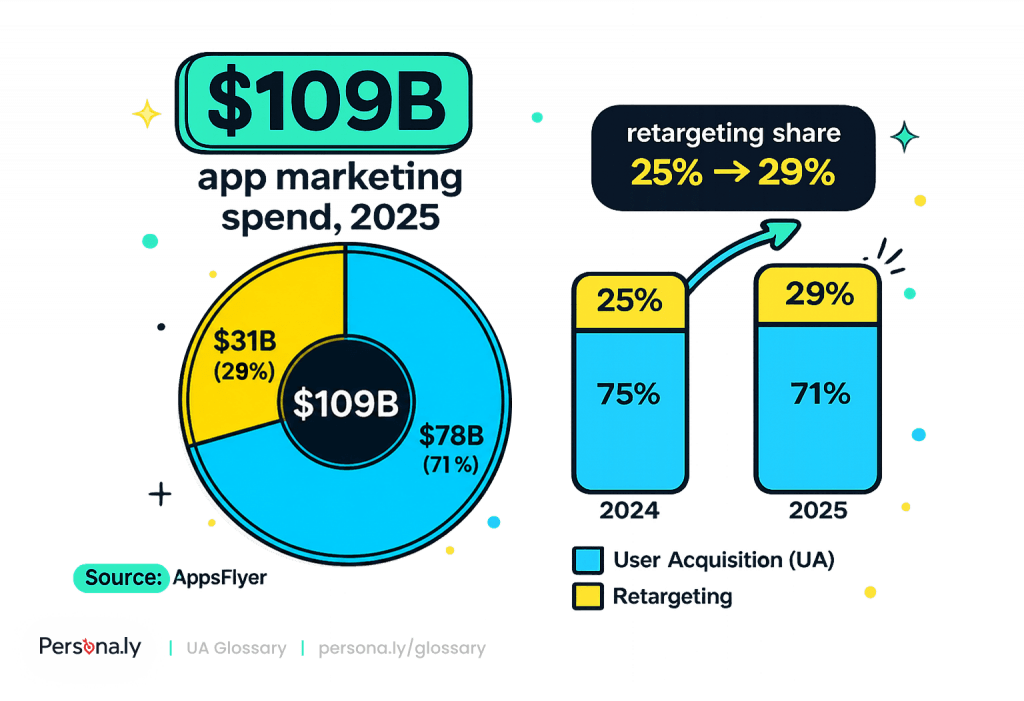
“AppsFlyer data shows an unmistakable trend: remarketing spend hit $31 billion in 2025, growing 37% year-over-year, and now accounting for 29% of overall app marketing spend, up from 25% just a year earlier. That’s not an accidental change, it’s a structural one. Furthermore, the growth wasn’t limited only to more mature Western markets. We saw geographic expansion into Central Europe, Latin America, and Southeast Asia, with several posting triple-digit gains. The reason is clear: as acquisition costs continue to rise, advertisers are recognizing that reactivating a known user is simply more cost-effective than fighting for a new one. We expect that logic to only get stronger through H2 2026, as the market matures into what’s shaping up to be a ‘retention-first’ economy.”
What drove this shift?
Retargeting vs. Re-engagement
The Distinction That Matters
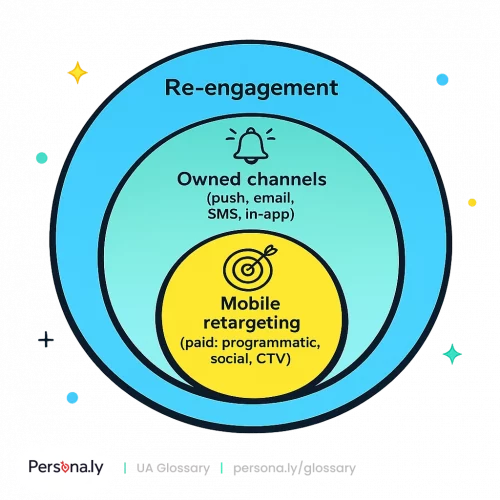
Before discussing mobile retargeting, it’s important to distinguish it from re-engagement.
Re-engagement is the broader practice of bringing inactive users back to your app through both owned and paid channels. Owned channels include push notifications, email, SMS, and in-app messaging.
Mobile retargeting, on the other hand, refers specifically to paid advertising campaigns – such as programmatic advertising, social media ads, and other paid media – that encourage existing users to return and complete actions inside the app.
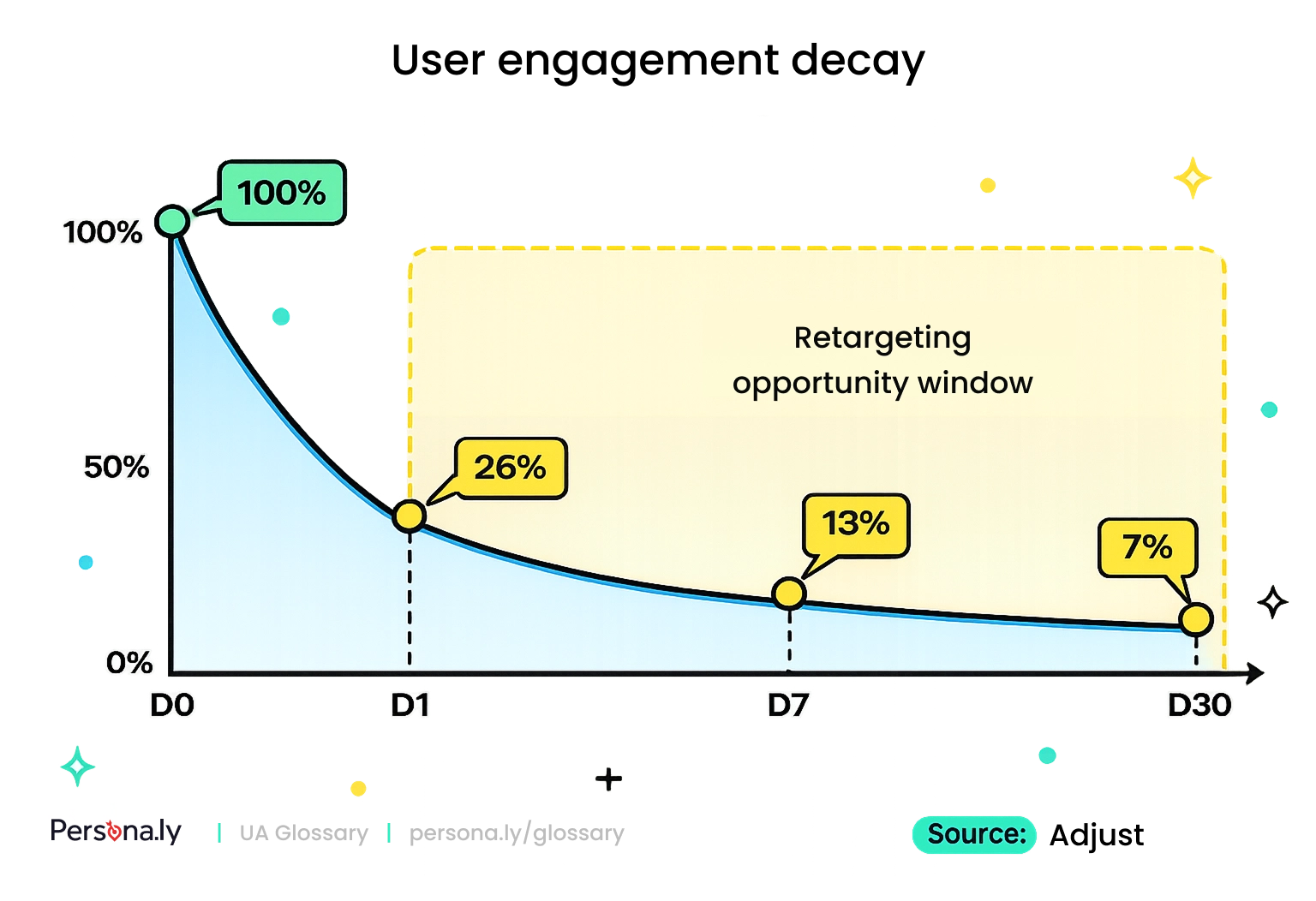
Retention remains one of the biggest pain points in mobile marketing. According to Adjust’s global retention benchmarks, only about 26% of newly acquired users open an app the day after installation, 13% stay by day 7, and roughly 7% remain active after 30 days. This rapid drop-off means that most marketing investment is lost unless brands actively bring users back through mobile retargeting and other re-engagement strategies.
Benchmarks Box: Where Does Your Vertical Stand? (2025–2026 data)
| Vertical | D1 retention | D7 | D30 | ATT opt-in (iOS) | Push CTR (Android / iOS) |
|---|---|---|---|---|---|
| Gaming | 29–33% | ~16% | ~8.7% | 40–50% (action/sports) | ~2.3% / ~1.8% |
| Fintech | 22–30% | ~17.6% | ~11.6% | ~25–30% | 2.84% / 2.09% |
| E-commerce | 18–24.5% | ~10.7% | ~5% | ~30% | 3.78% / 3.05% |
| Health & fitness | 20–27% | ~7% | ~3% | ~20–25% | ~2% / ~1.5% |
| All-app average | ~26% | ~13% | ~7% | ~35% | ~2.25% blended |
Sources: Adjust retention benchmarks, UXCam industry benchmarks, Adjust ATT opt-in data, 2025, Pushwoosh push benchmarks. Figures are directional industry medians – your app’s own cohort data always takes precedence.
Reading the box: the D7→D30 cliff is where retargeting earns its budget. Fintech’s unusually strong D30 (money is a daily habit) means longer inactivity windows; e-commerce’s purchase-cycle-driven pattern rewards cart-abandoner segments over blanket dormancy campaigns; gaming’s fast decay demands early, aggressive windows.
Rising CPMs have made acquiring high-value users significantly more expensive, while revenue growth has not kept pace. As acquisition costs increase, improving retention and maximizing customer lifetime value become essential.
Modern app users have more choices and shorter attention spans than ever before. Even well-designed apps experience natural user churn, making continuous engagement essential for long-term growth.
Even the most effective user acquisition strategies eventually face diminishing returns. Mobile retargeting helps marketers unlock additional value from users they have already paid to acquire. The math is intuitive: if you paid a $3 CPI and the user churned on day 3, a $0.30 re-engagement that restores them to the funnel protects the original investment at a tenth of the cost of replacing them. Adjust and others estimate retaining a user costs roughly five times less than acquiring a new one.
The CRM Ceiling
Traditional re-engagement channels – including push notifications, email, SMS, and in-app messaging – remain valuable, but they are becoming less effective on their own.
Push notification engagement has declined as users receive increasing volumes of notifications. Industry benchmarks now place average push notification click-through rates at roughly 2–3% across industries, highlighting the growing challenge of relying solely on owned channels. Owned channels also have a reach ceiling: push requires opt-in (and iOS opt-in is far from universal), email requires a captured address, and none of them can reach a user who uninstalled or disabled notifications. Paid retargeting is the only channel that reaches lapsed users wherever they actually spend time – inside other apps.

Combined with stricter privacy regulations, platform limitations, and growing competition for attention, these trends make programmatic re-engagement an increasingly important complement to CRM.
Competition Doesn’t Wait
Installing an app is only the beginning of the user journey. Every inactive user represents an opportunity – not only for you to win them back, but also for competitors to capture their attention.
In many app categories, the window for reactivating a dormant user lasts only days. Effective mobile retargeting helps brands reconnect before users permanently switch to competing apps.
iOS Retargeting Opened Back Up (Partly)
A final tailwind worth noting: Apple’s App Tracking Transparency (ATT) framework initially reduced retargeting reach on iOS. However, opt-in rates have gradually improved, expanding deterministic retargeting opportunities. Adjust’s 2025 benchmarks put the industry-average ATT opt-in at ~35% (with gaming verticals like sports reaching 50%), while AppsFlyer’s panel has measured even higher rates among apps that invest in pre-prompt design. Apple has also introduced AdAttributionKit, which – unlike SKAdNetwork – supports re-engagement attribution natively, signaling that privacy-preserving retargeting measurement is now part of Apple’s own roadmap.
At the same time, advances in probabilistic modeling have made programmatic re-engagement increasingly effective – even for users who have not granted tracking permission.
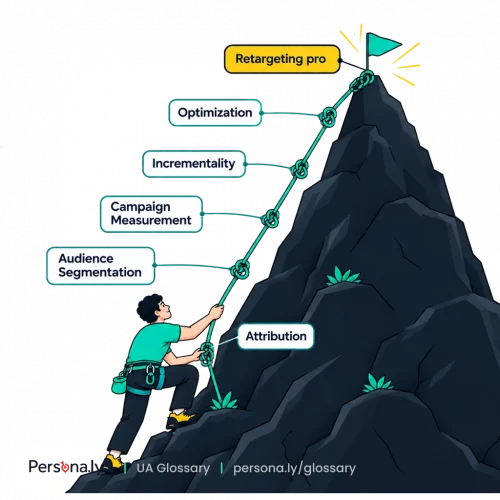
To hit the ground running with retargeting, learning the ropes is essential: marketers need to understand attribution, audience segmentation, campaign measurement, incrementality, and optimization to maximize key performance metrics. Each is covered in its own entry in this category: Measurement, DSP Mechanics, iOS Retargeting, Incrementality, Deep Linking, Retargeting Fraud, and CTV Retargeting.
The bottom line is simple: mobile retargeting is no longer an optional item to revisit when things are slow. As acquisition costs rise, retention declines, and owned channels become less effective, app retargeting has become a core pillar of sustainable mobile growth.
FAQ
What is mobile retargeting?
How does app retargeting work?
What’s the difference between retargeting and re-engagement?
Is mobile retargeting different from user acquisition?
When should you start retargeting app users?
Does mobile retargeting work on iOS?
What metrics should you track for mobile retargeting?
How much do app marketers spend on retargeting?



Thank you for your interest!
Our team will contact you with more details.