Your source for everything mobile UA, from UA basics to mobile retargeting, measurement and fraud, to contentious standards, the glossary can help and inform both aspiring growth managers and experienced mobile app developers
CTV Retargeting: How Connected TV Supports Mobile Re-engagement
Updated 6 min readBy The Persona.ly team
CTV retargeting uses Connected TV advertising to re-engage existing app users on the largest screen in their household. DSPs match mobile devices to TVs via household identity graphs, and returns are measured through view-through attribution and incrementality testing.
Connected TV (CTV) refers to internet-connected televisions and streaming devices, including Smart TVs, Apple TV, Fire TV, Roku, and Android TV. Unlike traditional linear television, CTV combines the reach of TV with the targeting, measurement, and optimization capabilities of programmatic advertising.
For mobile marketers, CTV has become an increasingly valuable extension of mobile retargeting. Instead of reaching lapsed users only on their phones, advertisers can reconnect with them on the largest screen in the household and continue the conversation across devices.
Why Use CTV for Retargeting?
The value of CTV isn’t the screen size – it’s the viewing environment. Unlike mobile users, who are often multitasking or consuming content in short bursts, CTV viewers are typically relaxed, engaged, and focused on long-form content. It creates an intent-light, attention-heavy environment: users may not be actively looking to take action, but they are far more likely to watch and absorb the entire message.
That level of attention is difficult to replicate on mobile. According to 2026 industry benchmarks, CTV ads achieve completion rates around 94–96%, largely because most CTV inventory is non-skippable – versus roughly 60% for comparable mobile video. Instead of competing with dozens of distractions on a smartphone, your message is delivered on the biggest screen in the home with the viewer’s full attention.
For programmatic re-engagement, this makes CTV particularly effective. Retargeting isn’t about introducing a new product – it’s about reminding users why they enjoyed your app in the first place. A 30-second video showcasing new features, content, or limited-time offers is often far more persuasive on a television than a banner or short video on a mobile device, making CTV a powerful complement to traditional mobile retargeting campaigns.
How Does CTV Retargeting Work?
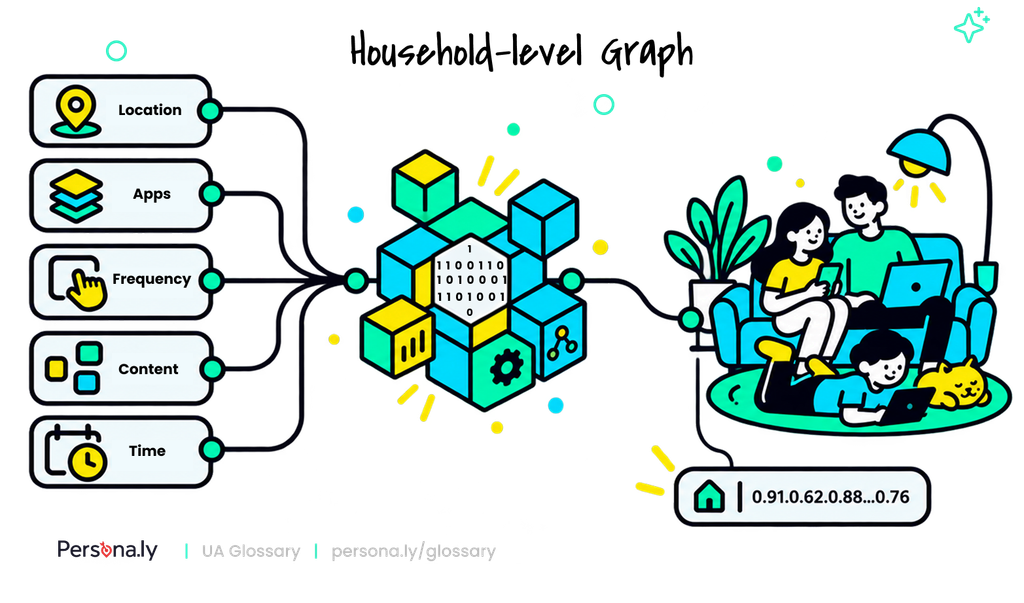
CTV retargeting works differently from traditional app retargeting because televisions don’t use mobile advertising identifiers such as IDFA or GAID. Instead, DSPs rely on household-level graphs to connect mobile devices, streaming devices, and other connected hardware within the same home.
These identity graphs combine deterministic and probabilistic signals – including IP address, geographic location, login relationships, connected devices, app usage, and content consumption patterns – to estimate which household is viewing an ad.
Rather than identifying a single individual, the DSP determines that a household contains a user who belongs to your retargeting audience and serves an ad on the connected TV. If that user later returns to the app on their mobile device, the conversion can be attributed back to the CTV campaign through cross-device measurement.
A mobile RPG identifies 200,000 lapsed payers. Its DSP matches ~60% of them to households via the identity graph and serves a 30-second trailer for a new game season on Fire TV and Roku. Over the following week, users from exposed households who reopen the game on their phones are measured via view-through attribution – and a 10% household-level holdout validates that the reactivations are incremental, not coincidental.
How Do You Measure CTV Retargeting?
Measuring CTV campaigns requires a different attribution model than traditional mobile advertising because CTV ads aren’t clickable. Instead, attribution relies on View-Through Attribution (VTA), where the MMP connects a CTV impression with a later app open or in-app event on another device.
Most leading MMPs support CTV, but proper configuration is essential. By default, click-based channels often receive attribution priority, meaning a subsequent mobile click can override an earlier CTV impression. If attribution settings aren’t configured correctly, CTV’s contribution may appear significantly smaller than it actually is.
Most advertisers extend the CTV view-through window beyond standard mobile settings (often up to 7 days) to account for delayed cross-device conversions. Cross-device matching should also be enabled so the MMP can connect CTV impressions with subsequent activity on users’ mobile devices.
Attribution alone doesn’t tell the full story. Because CTV often influences users rather than immediately converting them, incrementality testing remains the most reliable way to measure its true impact on mobile retargeting performance.
“CTV reengagement operates by a different set of rules than standard mobile campaigns, and advertisers who treat them the same will consistently undercount results or miss attribution entirely.
Most CTV ad units are impression-based; there is no click. This means view-through attribution must be explicitly enabled and configured for reengagement with your measurement partner. It is not always a default setting, and if it is not confirmed before your campaign goes live, you are flying blind from day one.
The second thing to get right is your lookback window. Mobile reengagement demand typically resolves within 24 hours of ad exposure. CTV behaves differently and we regularly observe a demand curve extending out to seven days. Someone sees your ad on TV Thursday night and reengages with your app on Sunday. If your window is set to 24 hours, that conversion is never properly attributed. Work with your measurement partner to open that window, potentially out to a full seven days, and lock in those configurations before launch. That is not a detail you want to troubleshoot after the fact.”
Grant Simmons VP, Kochava Foundry
Is CTV Worth Testing?
For apps with an established retargeting strategy, the answer is generally yes.
Connected TV gives advertisers access to existing users in a high-attention environment that complements traditional mobile campaigns. While measurement requires additional configuration and close attention to attribution settings, it also creates opportunities that mobile alone cannot offer. The channel’s trajectory supports the investment: US CTV ad spend is forecast to reach roughly $38 billion in 2026, and performance budgets are following audiences to streaming.
As with any new channel, success depends on disciplined execution. Clear incrementality testing, accurate attribution, and thoughtful audience segmentation are far more important than simply launching a campaign. Teams that build strong CTV measurement practices today will be well positioned as Connected TV continues to attract larger media budgets.
FAQ
What is CTV retargeting?
CTV retargeting uses Connected TV advertising to re-engage existing app users. Instead of serving ads on a smartphone, advertisers reach users through streaming services on their televisions and measure whether those users later return to the app.
What’s the difference between CTV and OTT?
CTV (Connected TV) refers to the device used to stream content, such as a smart TV or streaming stick. OTT (Over-the-Top) refers to the streaming content itself, delivered over the internet instead of traditional cable. CTV advertising is commonly delivered through OTT platforms.
How does CTV retargeting work?
CTV retargeting relies on household graphs rather than mobile device IDs. DSPs connect mobile devices and connected TVs using deterministic and probabilistic signals, allowing advertisers to reach existing app users across screens.
Can CTV ads drive mobile app engagement?
Yes. Although CTV ads aren’t clickable, they often encourage users to return to an app on their phone later. Attribution is typically measured through view-through attribution and supported by incrementality testing.
How is CTV retargeting measured?
Most advertisers measure CTV campaigns using view-through attribution (VTA), which connects a CTV impression with a later app open or conversion on a mobile device. Incrementality testing is often used alongside attribution to measure true campaign impact.
What creative works best on CTV?
High-quality video with simple messaging, large text, and a clear call to action performs best. For mobile retargeting, focus on reminding users about the value of your app, highlighting new features or content, and making it easy to continue the journey on their phone using a QR code.