


A DSP (Demand-Side Platform) is the technology that buys individual ad impressions in real time for mobile retargeting campaigns. In the 100-300 milliseconds of a programmatic auction, it identifies whether a user belongs to a retargeting audience, predicts their likelihood of returning, selects a creative, and calculates a bid.
To understand programmatic mobile retargeting, it helps to understand what happens inside a Demand-Side Platform (DSP).
In this article
What Happens Inside a DSP During an Ad Auction?
Every time an eligible user opens an app and appears on the bid stream, the DSP must decide – within a fraction of a second – whether to bid, how much to bid, and which creative is most likely to bring that user back.
During those few milliseconds, the DSP simultaneously:
- Identifies eligible campaigns and audience segments
- Predicts the likelihood of a user re-engaging
- Estimates the probability of downstream conversions or revenue
- Selects the most relevant creative
- Calculates the optimal bid price to maximize efficiency without overpaying
These real-time predictions determine whether your ad reaches the right user at the right moment – and whether that impression is likely to generate incremental value.
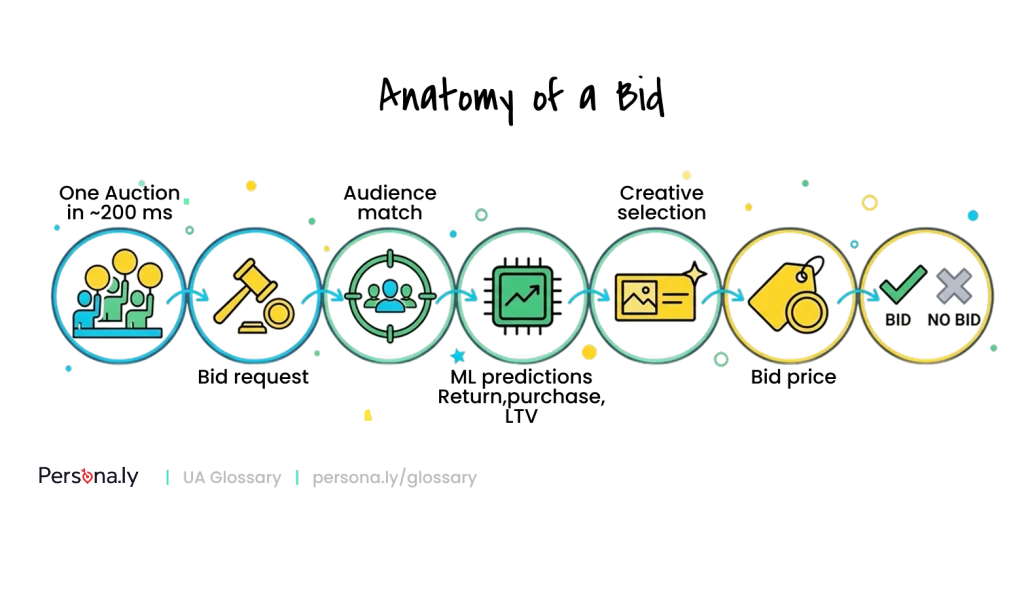
How DSPs Decide Which Users to Retarget
Successful mobile retargeting isn’t simply about reaching large audiences – it’s about identifying users who are most likely to return. While metrics such as LTV or the date of last activity provide useful context, they aren’t detailed enough for real-time bidding decisions.
Instead, modern DSPs rely on machine learning models trained on granular first-party signals, including the sequence, frequency, and timing of in-app events. These behavioral patterns help predict whether a dormant user is likely to re-engage or whether an active user simply needs an additional nudge to complete a valuable action.
For instance, two users may both be “7 days inactive,” but the one whose last sessions included a failed checkout, an abandoned cart, and a wishlist add represents dramatically higher re-engagement value than one who opened the app once and bounced. Event sequence and recency – not just inactivity duration – drive the bid.
Building High-Value Retargeting Audiences
Effective audience segmentation is the foundation of every successful app retargeting campaign. Rather than targeting all existing users, advertisers activate first-party data to build meaningful audience segments based on engagement, monetization, and user lifecycle.
Common segments include active purchasers, dormant users, non-paying users, high-value “whales,” cart abandoners, and users who recently completed key in-app events. Applying appropriate inactivity windows ensures these audiences become eligible for paid retargeting only after owned channels, such as push notifications or email, have had an opportunity to bring them back organically.
Once these audiences are defined, the DSP continuously evaluates each user’s historical behavior to estimate their probability of returning and generating future value. This allows bidding algorithms to focus budget on users who are statistically likely to re-engage, maximizing incremental ROAS (see the Incrementality entry) while avoiding unnecessary spend on users who would have returned naturally.
The Big Multiple DSP Myth
A common concern is whether running multiple DSPs causes cannibalization by making advertisers bid against themselves. In practice, this concern is often overstated because of how the programmatic ecosystem operates.
Supply Fragmentation and Duplicate Paths
The programmatic supply chain is highly fragmented. A single ad opportunity can reach advertisers through multiple exchanges, mediation platforms, and supply paths. No DSP has access to every supply path, so relying on a single partner inevitably limits your reach, leaving significant blind spots. Working with multiple DSPs can increase coverage rather than simply creating duplicate bids.
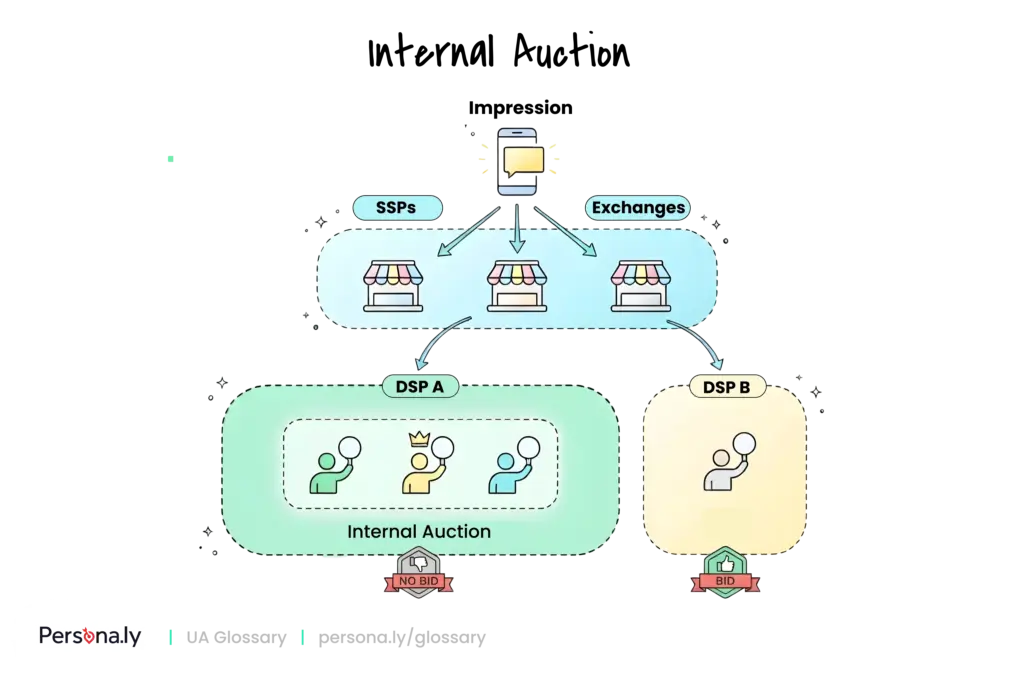
Internal DSP Auctions
Before participating in the external auction, every DSP runs an internal auction to decide which advertiser’s campaign will represent the platform. If your DSP already serves many advertisers competing for the same audience, your campaign may lose internally and never reach the open auction. Diversifying your programmatic footprint across an alternative DSP with fewer internal conflicts secures a cleaner, unhindered path to your users. This internal-auction dynamic is invisible in standard reporting: your campaign doesn’t “lose” the impression in any dashboard – it simply never bids, which looks identical to the impression not existing.
Market Pricing and High-LTV Audiences
High-value users naturally attract more competition. As multiple advertisers aggressively compete for a relatively small audience of high-LTV users, CPMs increase, reaching hundreds or thousands of dollars. Paying a few extra cents per impression on a small share of auctions to secure those users is almost always rational when the lifetime value is in the hundreds or thousands.
“In Singular, we see many advertisers running multi-DSP campaigns to increase their reach. Advertisers use Singular’s Multi-Touch Attribution and Advanced Assists to measure the overlap between DSPs, and optimize their campaigns to ensure they have high incremental reach across partners. A good practice for example is to monitor the Single-Attributed Rate metric per DSP, since it indicates the inventory “uniqueness” from that channel.”
Eran Friedman
CTO & Co-Founder at Singular
Key takeaways
- Deploying a multi-DSP strategy doesn’t automatically inflate media costs. Instead, it can improve reach, reduce dependence on a single supply path, and increase the likelihood of winning valuable impressions.
- The key is choosing transparent partners, validating incrementality, and continuously monitoring performance. Like every aspect of programmatic advertising, success depends as much on partner quality as on bidding strategy.
FAQ
What is a DSP in mobile retargeting?
A DSP (Demand-Side Platform) is the technology platform that buys ad impressions in real time for mobile retargeting campaigns. When a user opens an app, the DSP evaluates the ad opportunity, predicts the likelihood of re-engagement, and decides whether to bid, how much to bid, and which creative to show – all within a few hundred milliseconds. Read more on the data flow in programmatic auctions.
How does a DSP decide whether to bid on a user?
For app retargeting, a DSP analyzes first-party signals such as recent in-app events, purchase history, engagement patterns, and inactivity duration. Machine learning models estimate the probability that the user will return and generate future value. The DSP then compares that predicted value against the expected media cost before placing a bid.
How fast does a mobile ad auction happen?
Most programmatic mobile ad auctions happen in approximately 100–300 milliseconds. During that time, the DSP must identify eligible campaigns, evaluate the user, predict conversion probability, select a creative, calculate a bid price, and submit its response to the exchange.
What signals are most important for programmatic re-engagement?
The most valuable signals for programmatic re-engagement are usually behavioral rather than demographic. DSPs often prioritize the sequence, frequency, and timing of in-app events, purchase activity, session patterns, and historical engagement trends to predict whether a user is likely to return.
Why is audience segmentation important in app retargeting?
Audience segmentation helps advertisers focus budget on users with different levels of value and intent. Common app retargeting segments include dormant users, recent purchasers, cart abandoners, non-paying users, and high-value “whales.” Segmenting these audiences allows the DSP to apply different bidding strategies and creatives for each group.
What audience segments are commonly used in mobile retargeting?
Common app retargeting segments include: dormant users who haven’t opened the app recently, cart abandoners, recent purchasers, high-value payers (whales), and non-paying users with strong engagement signals. Segmenting audiences allows advertisers to personalize messaging and allocate budget more efficiently across different user groups.
Does using multiple DSPs increase advertising costs?
Not necessarily. In mobile retargeting, multiple DSPs can provide access to different supply paths, exchanges, and publisher relationships. While there may be some audience overlap, a multi-DSP strategy often increases reach and improves the chances of winning valuable impressions rather than simply inflating costs.
Can two DSPs bid on the same user?
Yes. In programmatic advertising, the same user may be available through multiple exchanges or supply paths. Two DSPs can bid on that opportunity simultaneously. However, because the ecosystem is highly fragmented, using multiple DSPs often expands coverage rather than creating complete duplication.
How do DSPs improve ROAS in mobile retargeting?
DSPs improve ROAS by using machine learning to predict which users are most likely to return, convert, and generate revenue. Instead of showing ads to every inactive user, the platform prioritizes impressions where the expected lifetime value exceeds the expected advertising cost.
Is programmatic re-engagement different from traditional retargeting?
Programmatic re-engagement is a form of retargeting that uses automated real-time bidding and machine learning to reach existing users across multiple apps and publishers. Traditional retargeting may rely on more limited channels or manual audience targeting, while programmatic platforms optimize bids and delivery dynamically at scale.
