Your source for everything mobile UA, from UA basics to mobile retargeting, measurement and fraud, to contentious standards, the glossary can help and inform both aspiring growth managers and experienced mobile app developers
Programmatic iOS Retargeting: A Guide to ATT, IDFA & Probabilistic Matching
Updated 5 min readBy The Persona.ly team
iOS retargeting is the practice of re-engaging existing app users on Apple devices. Since ATT (iOS 14.5), it combines deterministic matching for users who opt in to tracking with probabilistic, privacy-first approaches for those who don’t – and it’s growing fast: iOS remarketing spend rose ~71% year-over-year in 2025 per AppsFlyer.
iOS retargeting changed dramatically with the introduction of Apple’s App Tracking Transparency (ATT) framework. While ATT reduced access to device identifiers for many users, it didn’t eliminate mobile retargeting. Instead, it shifted the industry toward a combination of deterministic and probabilistic approaches.
Before iOS 14.5, advertisers could rely on Apple’s Identifier for Advertisers (IDFA) to recognize returning users across apps. ATT changed that by requiring users to explicitly opt in to tracking. Users who decline permission no longer make their IDFA available, limiting traditional deterministic retargeting.
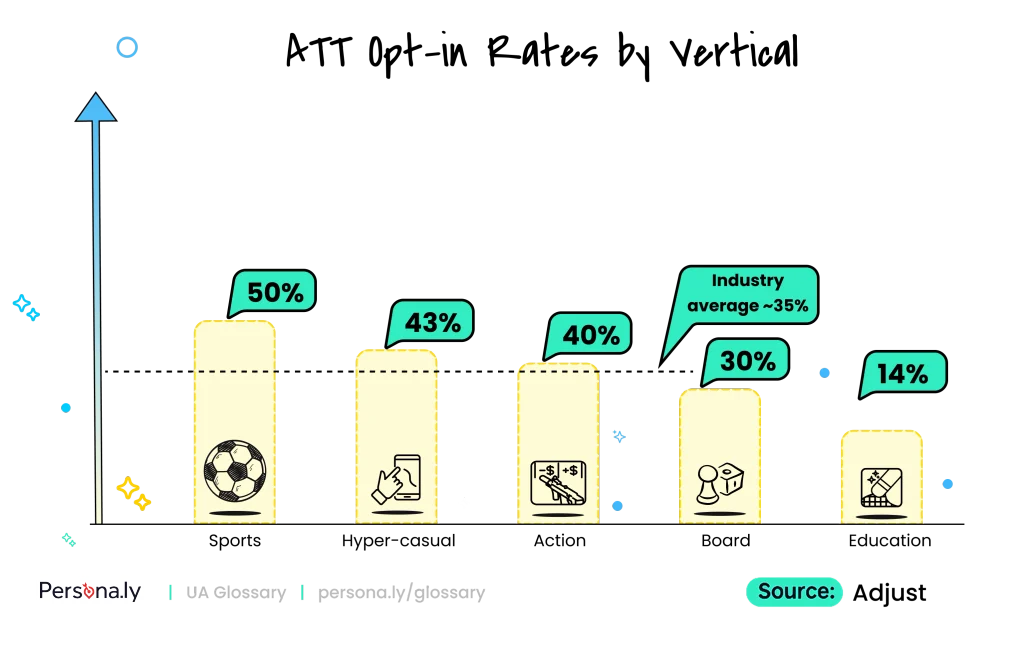
Roughly 30% of users initially granted tracking permission. Opt-in rates have climbed since: Adjust’s 2025 data shows an industry average of ~35%, with wide variance by vertical (sports games ~50%, hyper-casual ~43%) and geography. Everyone else requires privacy-first approaches based on probabilistic matching.
How Does Probabilistic Retargeting Work on iOS?
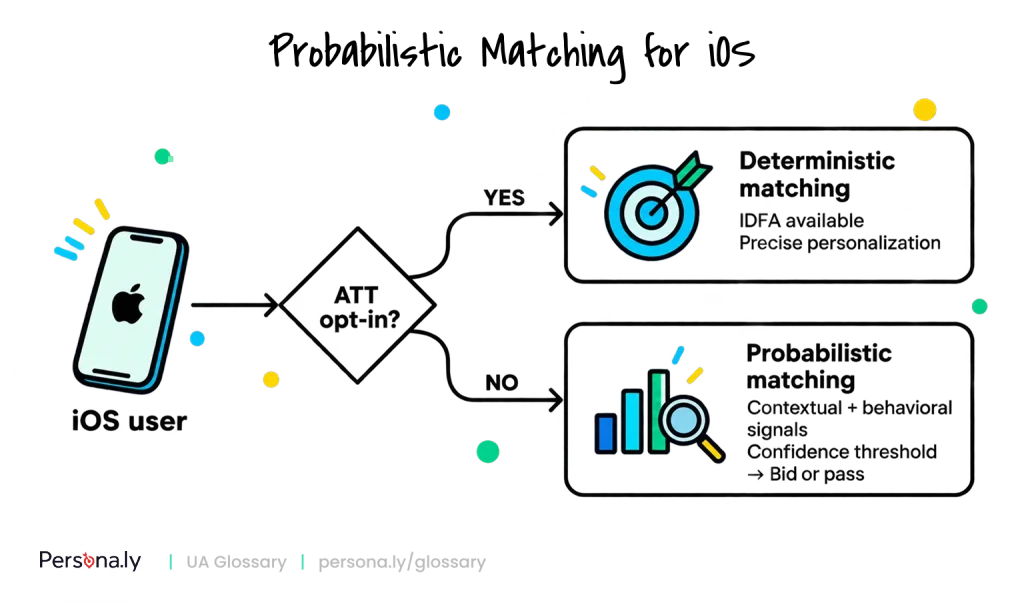
This created two distinct retargeting environments. For users who opt in to ATT, deterministic matching continues to work much as it did before, enabling precise user recognition and highly personalized campaigns.
For the opt-out majority, programmatic re-engagement relies on probabilistic matching. Rather than identifying a single user directly, DSPs analyze contextual signals – including publisher characteristics, available device information, app category, and behavioral patterns – to estimate the likelihood that an ad opportunity belongs to a particular audience. This is modelled bidding on contextual and behavioral signals from the ad opportunity, not identifying or tracking a device. This approach shifted the focus from individual profiling to granular behavioral context.
Probabilistic Matching: MMPs vs. DSPs
Both Mobile Measurement Partners (MMPs) and DSPs use probabilistic techniques, but they work with different data sets. MMPs typically rely on limited attribution signals such as IP address and user agent, which have become less detailed on modern iOS devices.
DSPs, by contrast, operate inside the real-time programmatic auction and can analyze additional contextual signals available during the bidding process. Combining these signals with machine learning helps improve confidence when estimating whether an ad opportunity belongs to a desired audience.
Because probabilistic matching is based on statistical confidence rather than deterministic identifiers, DSPs continuously evaluate signal quality. If confidence falls below an acceptable threshold, the platform simply chooses not to bid.
SKAdNetwork, Apple’s original privacy-preserving attribution framework, only ever measured installs – re-engagement was invisible to it. AdAttributionKit (AAK), introduced in iOS 17.4 and expanded through iOS 18.4, changes that: ad networks can now flag impressions as eligible-for-re-engagement, and when a user who already has the app installed taps an ad and returns, Apple itself sends a signed re-engagement postback – no IDFA required.
This matters for three reasons. First, it gives advertisers a deterministic, Apple-endorsed measurement path for iOS retargeting that works for opted-out users, complementing MMP probabilistic methods. Second, features like overlapping conversion windows and configurable attribution cooldowns (added in iOS 18.4) let marketers separate UA and re-engagement credit – reducing the cannibalization blind spots discussed in the Measurement entry. Third, it signals Apple’s long-term direction: retargeting is a recognized, supported activity in the privacy-first iOS ecosystem, not a workaround. For deeper technical comparisons, see Adjust’s AAK explainer and Singular’s analysis.
Adoption is still ramping – AAK postbacks are aggregate and delayed like SKAN’s, and don’t replace user-level MMP reporting – but any team running iOS retargeting in 2026 should have AAK re-engagement postbacks configured alongside their MMP setup.
“In Singular, we see that AdAttributionKit can provide good deterministic indicators of re-engagement volumes, so we recommend enabling it in any media channel that supports it. However, since it has only limited granularity, and delayed results, it’s important to use side-by-side with other methods such as deeplink-based attribution, Advertising IDs where possible and probabilistic/modeled signals.”
Eran Friedman CTO & Co-Founder, Singular
Creative Best Practices in iOS Retargeting
Creative strategy also changes in a privacy-first environment. Because many iOS users have explicitly declined tracking, overly personalized messaging can feel intrusive and reduce campaign effectiveness. Instead, focus on value-driven creatives that highlight new features, content updates, seasonal events, or limited-time offers. The goal is to remind users why they enjoyed the app – not to make them feel like they’re being individually tracked.
“The most effective retargeting creative understands the reason why someone has lapsed (or has yet to complete a desired action) and gives them a reason to return that really resonates, almost becoming unavoidable.
Many advertisers make retargeting assets in all creative dimensions, however, the smaller the asset dimensions, the harder it becomes to create a connection with the intended audience. Focusing on ‘larger’ creative (ad unit to screen size ratio) will be a stronger bridge back into your app.
In terms of prospecting creative, from a design perspective, this means strong visual hooks, clear hierarchy and simple storytelling. The creative needs to communicate quickly, be relevant and give the user a clear reason to pay attention.”
Rob Maclean-Eltham Senior Account Manager (UA), Yodel Mobile
FAQ
Does retargeting still work on iOS?
Yes. iOS remarketing spend grew ~71% year-over-year in 2025 (AppsFlyer). Advertisers combine deterministic matching for the ~35%+ of users who opt in to ATT with probabilistic matching for the rest.
What is the difference between deterministic and probabilistic retargeting?
Deterministic matching identifies a specific device via an identifier such as IDFA (requires ATT consent). Probabilistic matching estimates audience membership from contextual and behavioral signals with a statistical confidence score – no individual identifier involved.
What is AdAttributionKit?
Apple’s privacy-preserving attribution framework (iOS 17.4+) that succeeds SKAdNetwork and, unlike SKAN, supports re-engagement attribution – letting advertisers measure iOS retargeting via signed Apple postbacks without device identifiers.
What is the average ATT opt-in rate?
Industry averages sit around 35% (Adjust, 2025), with significant variance by vertical and country; well-designed pre-prompts push individual apps far higher.
Can you retarget users who opted out of ATT?
Individual-level targeting is not possible, but probabilistic programmatic re-engagement – bidding on contextual and behavioral signals rather than identity – reaches statistically likely audience members in a privacy-compliant way.