Your source for everything mobile UA, from UA basics to mobile retargeting, measurement and fraud, to contentious standards, the glossary can help and inform both aspiring growth managers and experienced mobile app developers
Mobile Retargeting Fraud: Common Types & How to Detect Them
Updated 5 min readBy The Persona.ly team
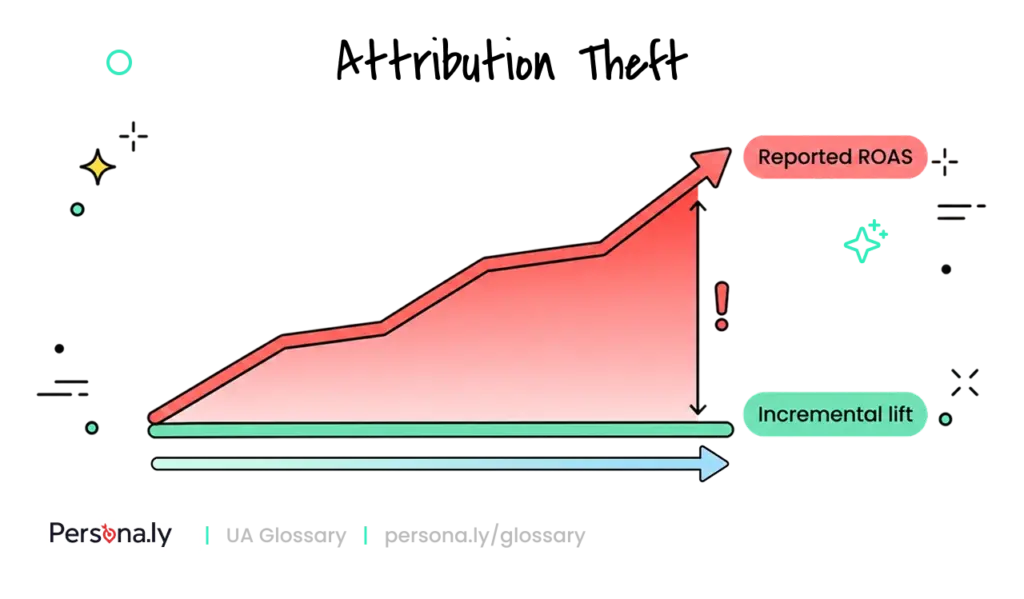
Mobile retargeting fraud is paid re-engagement activity that generates no incremental value – most commonly campaigns claiming credit for users who would have returned organically. Unlike install fraud, it usually looks like success: strong ROAS, healthy re-engagement rates, and nothing obviously fake.
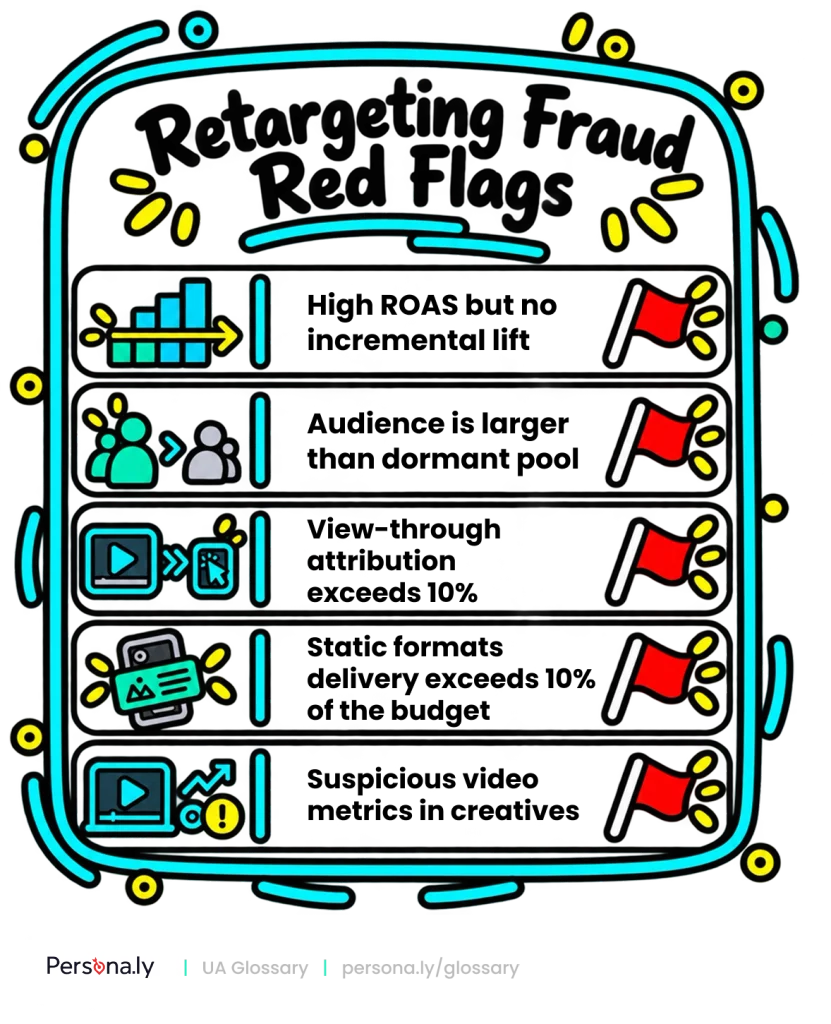
The stakes are growing with the budgets. Industry estimates place global mobile ad fraud exposure in the tens of billions of dollars annually (2025), and AppsFlyer’s fraud research shows fraud consistently migrating to wherever detection is weakest. As retargeting approaches a third of app marketing spend, according to Appsflyer, attribution-layer fraud – which exploits measurement rules rather than faking traffic – is where sophisticated operators have moved. That’s why every red flag below is a reporting pattern, not a bot signature.
“Fraud always follows the money. As install fraud detection matured, fraudsters rotated toward re-engagement and attribution, building fake organic user bases first, then claiming credit when retargeting campaigns run against them. We’re also seeing attribution spoofing rise fast, where fraudsters fabricate the entire chain — devices, users, events — from scratch. The signals that matter most now aren’t single indicators; they’re the ones that catch fabricated identity and behavior across the full user lifecycle, not just at install.”
Yoav Landesman Senior Product Manager, AppsFlyer
The examples below assume you’ve already completed basic due diligence on your partners. These are the warning signs worth monitoring even when working with legitimate DSPs.
The most common form of retargeting fraud doesn’t involve bots or fake clicks. Instead, it happens when a campaign receives credit for users who would have returned to the app without seeing an ad. On paper, the campaign looks highly successful, with strong ROAS and impressive re-engagement metrics. In reality, it isn’t creating any incremental value – it is simply taking credit for behavior that would have happened organically.
How to catch it: Run regular incrementality tests using a holdout group. Compare return rates between users who saw ads and those who didn’t. If both groups perform similarly, the campaign is likely benefiting from over-attribution rather than driving genuine incremental lift.
Inflated Audiences via Inactivity Window Manipulation
The inactivity window determines when a user becomes eligible for a retargeting campaign. If a partner ignores or manipulates this window, the audience appears much larger than it actually is because active users are incorrectly classified as dormant. The result is inflated campaign volume, unnecessary media spend, and misleading performance metrics.
How to catch it: Compare your DSP’s reporting with raw MMP exports. Verify that users entered the campaign only after meeting your configured inactivity window. Sudden increases in audience size without corresponding increases in dormant users should also raise questions.
VT/CT Ratio Imbalance
Healthy mobile retargeting campaigns typically generate more click-through than view-through conversions. When view-through attribution consistently outweighs click-through attribution, impressions may simply be taking credit for users who were already planning to return.
How to catch it: Monitor your VT/CT ratio regularly. If view-through conversions represent an unusually large share of attributed conversions, review placement quality, creative formats, and incrementality testing results. High view-through performance without corresponding incremental lift is a strong warning sign.
Over-Reliance on Banner Inventory
Banner ads are inexpensive and easy to scale, but they often generate large numbers of impressions with very little real user engagement. In retargeting, this can create campaigns that appear successful through view-through attribution while contributing little actual re-engagement.
How to catch it: Break down performance by creative format. If banners account for most impressions and attributed conversions while generating low click-through rates and weak incremental lift, they’re likely adding noise rather than value (and claiming credit for users who would have returned organically). Compare banner performance against video or interstitial campaigns before allocating additional budget.
Video Loop Manipulation
A less common issue involves video creatives that continuously loop or make it unnecessarily difficult for users to dismiss the ad. These placements can artificially inflate video completions, clicks, and engagement metrics without reflecting real user intent.
How to catch it: Regularly review the creatives running in your campaigns – not just the reporting. Inspect how ads behave in real placements using your MMP’s creative dashboard or by requesting placement previews from your partner. If engagement metrics look unusually strong, verify that users can exit the ad naturally and that interactions aren’t being forced.
“Be on the lookout for excessive click or impression volume paired with strikingly low conversion rates, and reengagement costs that look almost too good to be true. Both are indicators of click flooding or impression spam designed to intercept organic, post-install activity.
On the controls side, your measurement partner should give you meaningful levers. With Kochava, you can define the specific conversion event that qualifies as a reengagement; not just any app open, but a lower funnel action (e.g., add to cart, purchase, registration). Set a minimum time to reengagement so a highly active user cannot be claimed over and over by successive clicks or impressions. Further, if you’re running multiple ad networks against the same reengagement audience, segment them, albeit by geography or another delineation. Too much inventory overlap creates exactly the conditions where bad actors thrive and over-attribution goes undetected.
Reengagement fraud is more targeted and more surgical than install fraud ever was. The good news is that the countermeasures are equally precise. Have that conversation with your measurement partner before you scale.”
Grant Simmons VP, Kochava Foundry
FAQ
What is mobile retargeting fraud?
Mobile retargeting fraud occurs when advertisers pay for re-engagement that doesn’t generate genuine incremental value. Rather than creating new conversions, fraudulent or low-quality campaigns often take credit for users who would have returned organically.
How can I detect retargeting fraud?
The most effective methods include incrementality testing, reviewing raw MMP reports, validating inactivity windows, monitoring click-through versus view-through attribution, and regularly auditing creatives and placements.
What is attribution theft in retargeting?
Attribution theft occurs when a retargeting campaign claims credit for users who were already likely to return to the app without advertising. While reported ROAS may appear strong, the campaign contributes little or no incremental value.
Are high view-through conversions always a sign of fraud?
No. View-through attribution is an important measurement method, particularly for channels such as CTV. However, unusually high view-through rates in display campaigns should be investigated to ensure impressions are genuinely influencing user behavior.
Why should I monitor the inactivity window in retargeting campaigns?
The inactivity window determines when users become eligible for retargeting. If it’s ignored or manipulated, advertisers may pay to target users who were never truly dormant, leading to wasted budget and overstated campaign performance.
Are banner ads a good choice for retargeting?
Banner ads can work in some scenarios, but they generally produce weaker engagement than video or full-screen formats. Heavy reliance on banner inventory may also increase passive view-through attribution, making campaign performance harder to evaluate accurately.