Your source for everything mobile UA, from UA basics to mobile retargeting, measurement and fraud, to contentious standards, the glossary can help and inform both aspiring growth managers and experienced mobile app developers
Deep Linking for Mobile Retargeting: How It Works & Best Practices
Updated 5 min readBy The Persona.ly team
A deep link routes a user who clicks a mobile retargeting ad directly to a specific in-app destination – a product page, game level, or offer – instead of the app’s home screen. By removing steps between click and conversion, deep linking is one of the highest-ROI improvements available to retargeting campaigns.
Deep linking is one of the simplest ways to improve the performance of mobile retargeting campaigns. Returning users already know your app – they’ve installed it before, engaged with it, and often completed valuable actions. Instead of making them start from the home screen, deep links take them exactly where they need to go, reducing friction and turning intent into action.
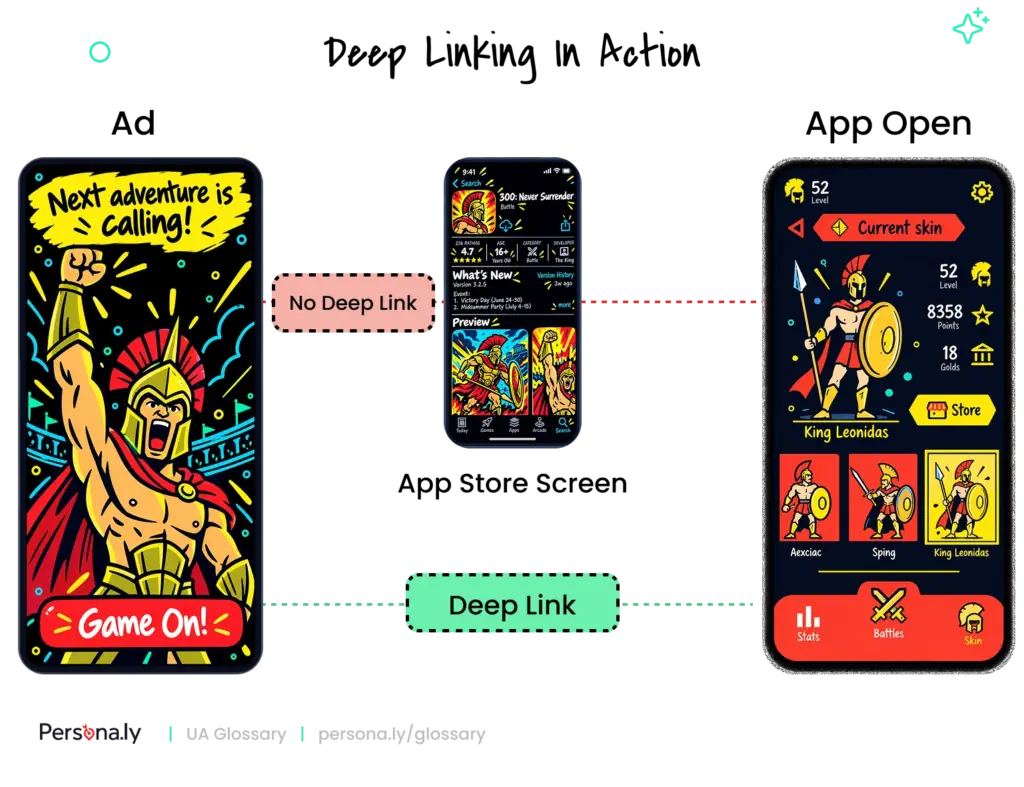
A deep link directs users to a specific destination inside your app after they click an ad, such as a product page, a game level, a promotional offer, or a personalized screen. Instead of sending every returning user to the same landing page, deep linking creates a seamless experience by matching the destination to the user’s intent and the message shown in the ad.
In programmatic re-engagement, this continuity is especially valuable. The promise made in the creative is fulfilled the moment the app opens, reducing drop-off and increasing the likelihood of conversion.
How Does Deep Linking Work in Retargeting?
All major MMPs natively support deep linking. Implementation requires developers to add deep link functionality to the app, while the MMP handles attribution and ensures users are routed to the correct destination without disrupting measurement.
Once implemented, deep links work seamlessly alongside your existing attribution setup and CRM workflows, making them easy to integrate into app retargeting campaigns.
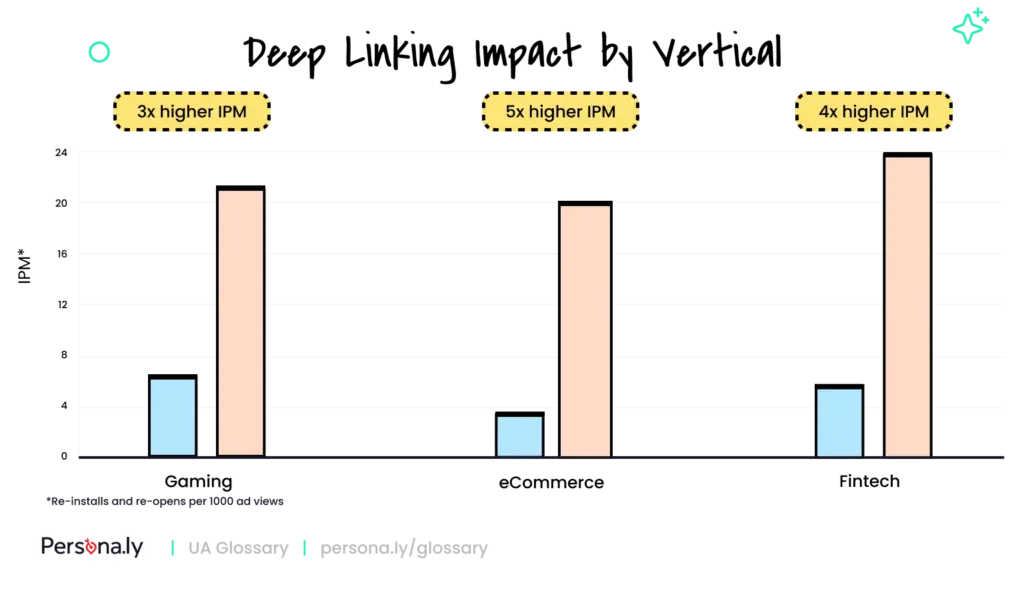
The impact is often immediate. By reducing the number of steps between clicking an ad and completing an action, deep linking can significantly improve engagement, conversions, and campaign efficiency. Persona.ly campaign data (2026) shows 3–5x higher re-attributions per mille (re-installs and re-opens per 1,000 ad views) with deep linking.
A fashion app retargets cart abandoners with a creative showing the exact bag left in the cart plus a 10% incentive. Without a deep link, the click opens the app’s home screen and the user must re-find the product – most won’t. With a deep link, the click opens the cart with the discount applied. Same media spend, same creative, radically different conversion path. This creative-to-destination continuity is why deep linking compounds with the audience segmentation covered in the DSP Mechanics entry.
“UA creative buys a stranger’s attention, whereas retargeting creative recovers value you’ve already paid for. The player knows the game exists – what they need is a reason to reopen it. A tutorial churner gets the mid-game they never reached, an engaged non-payer gets the offer, a lapsed payer gets what changed since they left, and every ad deep-links to where that promise lives. At AppAgent, where we run UA and creative production under one roof, this is exactly why we never build retargeting ads as an afterthought to UA. The worst thing you can do is recycle the winning UA static /video with a new CTA – players recognize it, skip it, and you pay premium CPMs to be ignored by people who already like your game.”
Virendra Shekhawat Sr. Growth Manager, AppAgent
What Are the Best Practices for Deep Linking in Retargeting?
Start simple. Begin with one universal deep link that reliably opens the app (falling back to the store if it isn’t installed). Even this basic implementation creates a smoother user experience and gives your DSP a consistent destination for optimization.
Once your campaigns are running smoothly, expand to personalized deep links. Route different audience segments – such as lapsed payers, recent purchasers, cart abandoners, or high-value users – to destinations that match their previous behavior and the message shown in the ad.
This is where deep linking delivers its greatest value. Combining first-party audience segmentation, CRM insights, and personalized in-app destinations creates a seamless user journey that improves both conversion rates and long-term retention.
The sweet spot is balancing simplicity with personalization. Start with a universal deep link to establish a reliable foundation, then gradually introduce more tailored destinations as your audience segmentation matures. The more relevant the destination, the more effective your mobile retargeting campaigns become.
“The biggest differentiator is whether the creative gives users a real reason to come back. Creative fatigue happens when people keep seeing the same message without anything new to react to, so it just blends into the background and gets ignored. Strong retargeting creatives do the opposite. They break that pattern by bringing in something fresh, such as a new feature, updated offering, limited-time promotion, customer proof, or a different angle that makes the brand worth coming back to.“
Yanina Velikova Director UA, Admiral Media
FAQ
What is deep linking in mobile retargeting?
Deep linking is the practice of sending users who click a mobile retargeting ad directly to a specific screen, such as an app’s home screen or app store page. This creates a smoother user experience and reduces the steps required to complete an action.
Why is deep linking important for app retargeting?
Returning users already know your app and often have a clear intent. App retargeting campaigns that use deep links remove unnecessary friction by taking users directly to the most relevant content, helping improve engagement and conversion rates.
How does deep linking work?
When a user taps a retargeting ad, the deep link contains routing information that tells the app which screen to open. MMPs handle attribution while ensuring users arrive at the correct in-app destination.
Do I need an MMP to use deep linking?
While apps can implement deep links without an MMP, most advertisers use one because it combines deep linking with attribution, deferred deep linking, campaign measurement, and programmatic re-engagement reporting.
What is deferred deep linking?
Deferred deep linking allows users who don’t have the app installed (new users, or lapsed users who uninstalled) to be directed to the app store first and then automatically routed to the intended in-app destination after installation. Although it’s more commonly associated with user acquisition, it can also support cross-device and re-install scenarios.
Does deep linking improve retargeting performance?
Yes. By reducing friction between ad click and conversion, deep linking typically improves user engagement, conversion rates, and campaign efficiency. It also creates a more personalized experience by directing users to content that matches the ad they clicked.
What are deep linking best practices?
Start with a universal deep link that opens the app reliably for all users. As your mobile retargeting strategy matures, introduce audience-specific destinations based on user behavior, purchase history, and CRM data. Personalized deep links generally deliver stronger engagement than sending every user to the same screen.
How do I implement deep links in my app?
Implementing deep links typically involves two steps. First, your development team configures the app to support deep linking (using technologies such as Universal Links on iOS and App Links on Android) and defines which in-app screens can be opened directly. Second, your MMP configures attribution and routing so users are taken to the correct destination after clicking a mobile retargeting ad. Most leading MMPs, including AppsFlyer, Adjust, and Singular, provide implementation guides and SDKs, making deep linking a relatively straightforward addition to an existing app.