


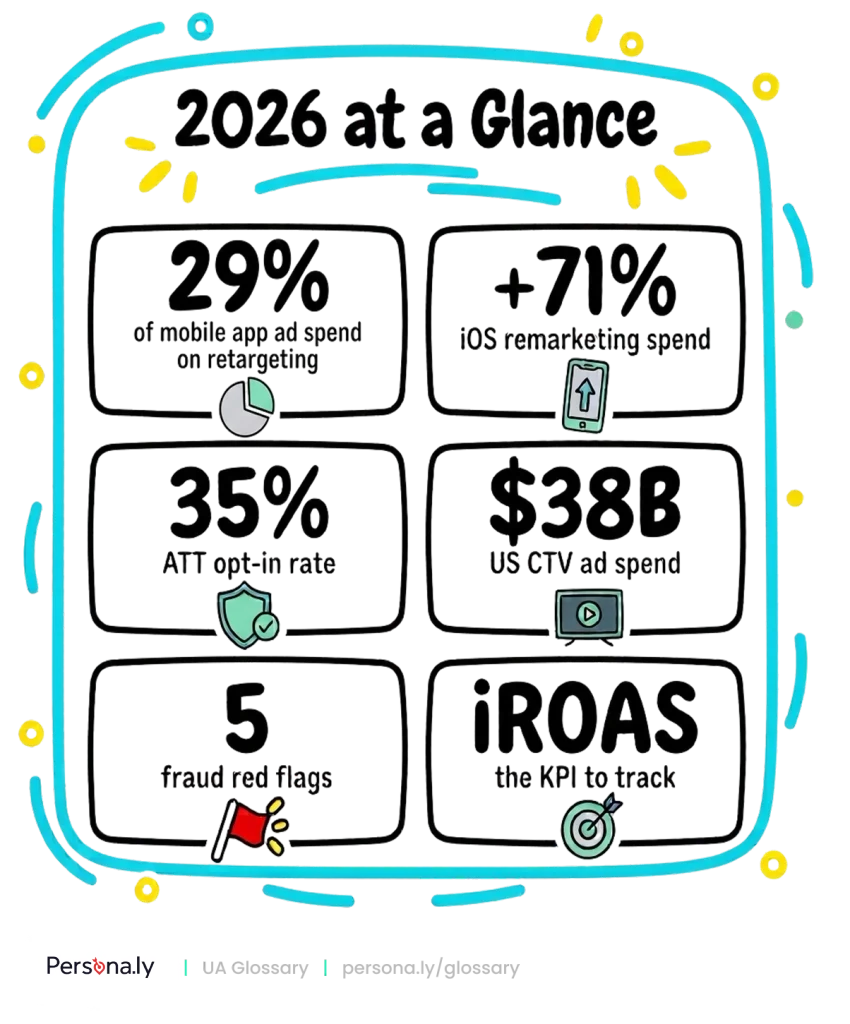
Mobile retargeting in 2026 is defined by a budget shift toward re-engagement (29% of app marketing spend), a measurement renaissance on iOS, incrementality replacing last-touch ROAS as the buying currency, and fraud migrating to the attribution layer. Here are the seven trends that matter, with data.
In this article
- Retargeting Now Takes Nearly a Third of App Marketing Budgets
- iOS Is the Growth Engine Again
- AdAttributionKit Makes iOS Re-engagement Officially Measurable
- Incrementality Becomes the Buying Currency
- AI Moves to Both Sides of the Auction
- CTV Graduates from Experiment to Re-engagement Surface
- Fraud Migrates to the Attribution Layer
- FAQ
Retargeting Now Takes Nearly a Third of App Marketing Budgets
Of the $109 billion spent on app marketing in 2025, $31.3 billion went to remarketing – up 37% year-over-year, lifting retargeting’s share of total spend from 25% to 29%. The driver is arithmetic, not fashion: UA costs keep rising while D30 retention sits around 7%, so the cheapest growth available to most apps is inside their own install base. Expect the share to keep climbing; when a third of budgets ride on re-engagement, retargeting stops being a side campaign and becomes an owned discipline with its own measurement stack, creative pipeline, and partner roster.
What to do: if retargeting is still a line item inside your UA plan, split it out – own budget, own KPIs (incremental ROAS, not blended ROAS), own testing roadmap.
iOS Is the Growth Engine Again
iOS remarketing spend grew ~71% year-over-year in 2025 to roughly $17 billion, versus 10% growth on Android (AppsFlyer). Three forces converged: ATT opt-in rates stabilized around 35% industry-wide (much higher in gaming verticals), probabilistic re-engagement matured from workaround to workhorse, and finance led vertical growth with a 61% YoY increase in iOS activity. The Remerge × AppsFlyer iOS re-engagement report documents the operational playbook that emerged.
What to do: if you paused iOS retargeting in 2021 and never revisited, you’re leaving the fastest-growing segment of the market to competitors. Re-test with current opt-in rates and probabilistic capabilities before assuming it “doesn’t work post-ATT.”
AdAttributionKit Makes iOS Re-engagement Officially Measurable
AdAttributionKit (iOS 17.4+, expanded in 18.4) is the first Apple framework to natively attribute re-engagement, not just installs – signed postbacks, no IDFA, with configurable conversion windows and cooldowns that help separate UA from retargeting credit. SKAdNetwork never saw retargeting at all; AAK’s eligible-for-re-engagement flag makes it a first-class citizen (Adjust explainer, Singular analysis). Postbacks remain aggregate and delayed, so AAK complements rather than replaces MMP measurement – but the direction is unmistakable: privacy-preserving retargeting is part of Apple’s roadmap, not a gray zone.
What to do: configure AAK re-engagement postbacks alongside your MMP now; the teams that accumulate AAK data early will calibrate probabilistic models against it first.
Incrementality Becomes the Buying Currency
As deterministic attribution weakens and view-through channels (CTV, native, banners) grow, last-touch ROAS increasingly rewards whoever claims credit best, not whoever creates value. In response, lift measurement is moving from annual science project to always-on practice: MMPs ship productized holdout testing, and mobile-focused independents like INCRMNTAL and MetricWorks offer continuous, experiment-free incrementality. The sophisticated buyer’s question in partner reviews has changed from “what’s your ROAS?” to “what’s your incremental ROAS, and how was it measured?”
What to do: put a permanent 10% holdout behind every major retargeting partner and re-negotiate on iROAS. Partners who resist holdouts are answering the question for you.
AI Moves to Both Sides of the Auction
On the bidding side, DSP models now predict return probability and future LTV per impression from event-sequence data (see the DSP Mechanics entry). The 2026 shift is on the creative side: generative pipelines produce segment-specific variants at scale – lapsed-whale messaging distinct from cart-abandoner messaging distinct from day-5-dormant messaging – collapsing the historical trade-off between personalization and production cost. Creative is becoming the main optimization surface precisely because targeting precision is privacy-capped: when you can’t target the individual, the message has to do more work.
What to do: match your segmentation granularity with creative granularity. If you have eight audience segments and three creatives, five segments are seeing someone else’s message.
CTV Graduates from Experiment to Re-engagement Surface
US CTV ad spend approaches $38 billion in 2026 and app advertisers already account for a meaningful share of it. For retargeting specifically, household identity graphs plus extended view-through windows make lapsed-user reactivation on the TV screen measurable – with ~95% completion rates on non-skippable inventory. The full mechanics are in the CTV Retargeting entry; the trend line is that CTV is being bought with re-engagement KPIs, not reach KPIs.
What to do: start with lapsed high-LTV segments (first-party audiences, narrower measurement question), validate with a household-level holdout, and only then expand toward prospecting.
Fraud Migrates to the Attribution Layer
As detection hardened around install fraud, operators moved to where the money went: re-engagement. The 2026 patterns are attribution-layer exploits – organic-credit theft, inactivity-window manipulation, view-through inflation – that produce beautiful dashboards and zero lift (AppsFlyer State of Fraud; industry fraud statistics). The defense converges with the incrementality trend above: incrementality testing doubles as fraud detection, because fraudulent supply is precisely supply that shows attribution without lift.
What to do: treat the five red flags in the Retargeting Fraud entry as a standing monthly review, not an incident response.
FAQ
What are the main mobile retargeting trends in 2026?
In 2026, mobile retargeting is shaped by a few important industry developments. iOS is seeing renewed growth, with Apple’s AdAttributionKit opening up new measurement opportunities. At the same time, incrementality is gaining importance as marketers look to understand what their campaigns actually deliver. AI is making bidding and creative personalization more efficient, while CTV is opening up new ways to re-engage lapsed users. For mobile marketers, these developments mean more opportunities to measure real impact, make smarter budget decisions, and bring users back to their apps.
Why is incrementality measurement becoming more important in mobile retargeting in 2026?
In 2026, incrementality is gaining importance as mobile marketers seek more reliable ways to evaluate retargeting performance beyond attributed conversions. At Persona.ly, 65% of our clients request incrementality testing during onboarding. While attribution assigns credit for conversions to advertising touchpoints, incrementality measures whether those conversions would have happened without the campaign. By comparing exposed and control groups, advertisers can identify which campaigns generate additional results, allocate budgets more effectively, and make better-informed scaling decisions.
How is AI used in mobile retargeting in 2026?
AI enables smarter bidding and more personalized creatives in mobile retargeting campaigns. Machine learning models analyze user behavior to predict the likelihood of return and future value, helping DSPs make better impression-level bidding decisions. Generative AI also makes it easier to tailor creatives to different audience segments, from lapsed high-value users to cart abandoners, making personalization more scalable and campaigns more efficient.
